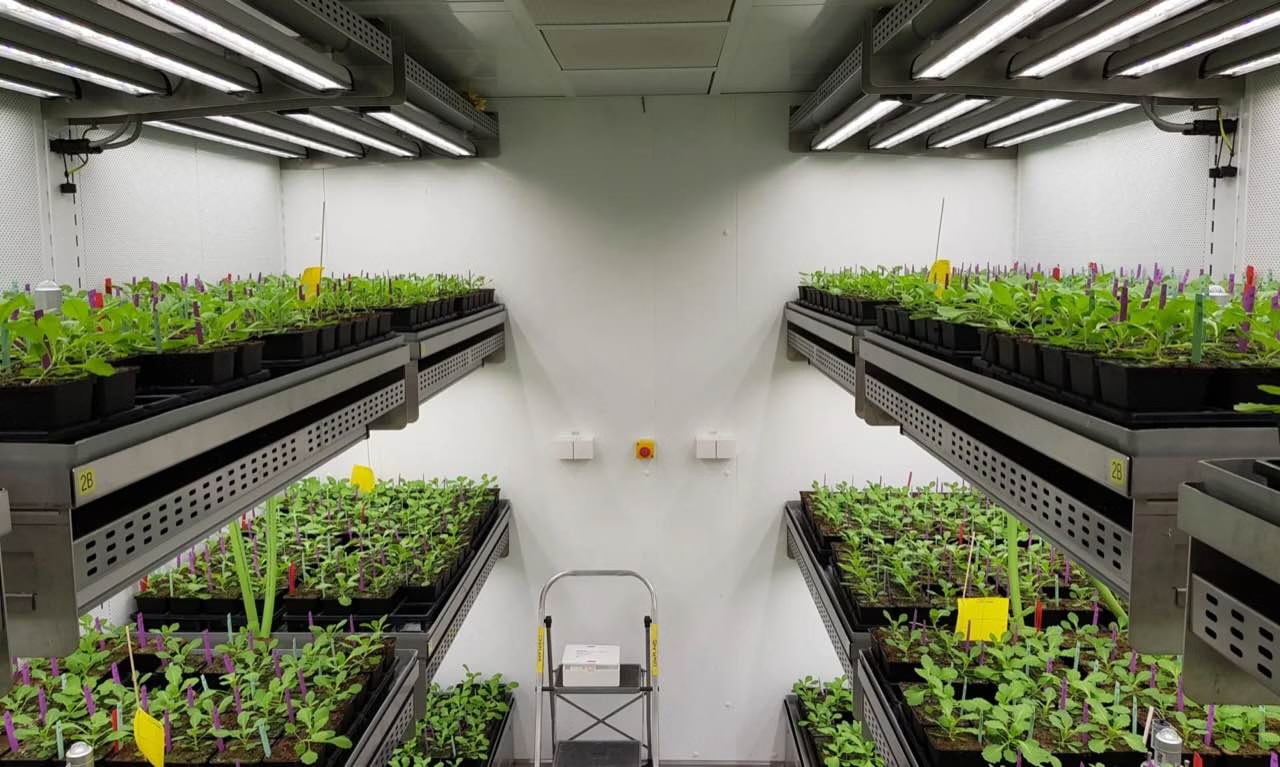

A useful plant research lighting specification connects the biological question to a measurable light treatment. Define spectrum, photon flux, distribution and timing together, then check how the lighting interacts with the cabinet or climate room.
Bronson Climate is a system integrator of Valoya lighting. We bring the lighting layout, selected luminaires and controls into the discussion about your complete research environment.
Start with the research question
Record the species, cultivar, growth stage and response being studied. A germination trial, tissue-culture rack, flowering experiment and crop-protection bioassay need different experimental designs. Identify which lighting variables will change between treatments and which must remain consistent.
State the usable growing area and the expected plant height at the end of the study. Include pots, trays, shelf spacing, access and the number of independent treatments. A fixture rating alone cannot describe the conditions received by every plant.
Separate spectrum, PPFD and daily light integral
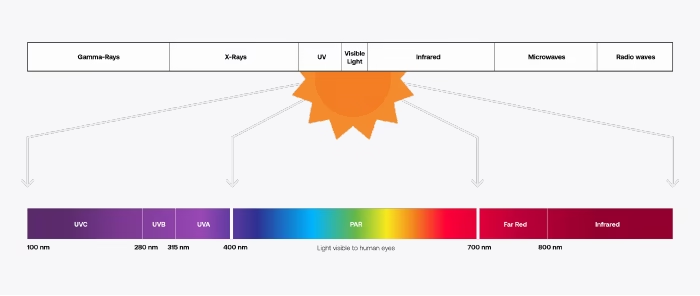
Spectrum describes how radiation is distributed across wavelengths. Conventional photosynthetically active radiation (PAR) covers 400–700 nm. UV and far-red should be specified separately; two sources with the same conventional PPFD can have different UV or far-red content.
PPFD, expressed in µmol m⁻² s⁻¹, describes the photon flux density within the stated photosynthetic waveband at a measurement plane. Specify that waveband, the instrument, sensor orientation and height. Electrical watts, lux and colour temperature do not replace a PPFD measurement.
Daily light integral (DLI) expresses the accumulated photosynthetic photon dose per day in mol m⁻² d⁻¹. At constant PPFD, DLI = PPFD × lighting hours × 0.0036. For example, 200 µmol m⁻² s⁻¹ for 16 hours gives 11.52 mol m⁻² d⁻¹. This is a calculation example, not a recommended treatment for a species. For a changing light schedule, calculate the contribution of each interval.
Specify uniformity at the growing plane
Ask for a light-distribution map across the usable area, not just a maximum reading below the centre of a luminaire. Agree the measurement grid and report minimum, mean and maximum values. If a uniformity ratio is used, define its calculation, such as minimum divided by mean.
Keep mounting height, shelf reflectance, plant positions and dimming settings with the measurement record. Repeatability depends on the arrangement as well as the light source. As the canopy rises, the distance to the luminaires and the distribution can change.
Match spectra to the experimental objective
- General growth and tissue culture: consider plant size, shelf spacing and the treatment at vessel or canopy height. Valoya’s Crop Science guide discusses Lumi-CS for several closed-environment and in-vitro applications; confirm the selected fixture and layout for your protocol.
- Daylight-oriented studies: the guide discusses NS1, NS12 and Solray385 for different settings. A daylight-oriented spectrum is not automatically a complete recreation of outdoor sunlight. Specify the UV and far-red components and any daily changes that matter to the study.
- Flowering and speed breeding: spectrum, intensity and photoperiod can affect development. Responses depend on species, cultivar and the wider protocol. Supplier examples do not establish a guaranteed number of generations per year for another crop.
Treat an LED retrofit as a controlled change
Replacing fluorescent, metal-halide or other lamps changes more than electricity consumption. Compare spectral distribution, PPFD across the growing plane, photoperiod and any UV or far-red contribution before choosing a replacement. Also reassess the heat balance and climate settings.
For an ongoing study, record the original conditions and agree a transition or comparison trial where appropriate. Do not assume an LED fixture is an equivalent biological treatment because its appearance or electrical wattage is similar.
Adding UV to a plant research protocol
Valoya’s UV guide describes narrowband options with nominal peaks at 280, 308, 365 and 385 nm. These represent distinct treatments, not interchangeable versions of the same light. Confirm the current product specification, spectral bandwidth and intended application with the supplier.
Define the wavelength, spectral irradiance or band-integrated irradiance, measurement plane, background light, exposure schedule and plant material. UV treatment dose is commonly expressed in J m⁻²: for constant irradiance, dose equals W m⁻² × exposure seconds. A conventional PAR quantum sensor alone does not establish the UV dose.
UV can be investigated for signalling, acclimation, pigmentation, secondary metabolites or microbial control, depending on the waveband and protocol. Beneficial responses, crop injury and treatment effectiveness are dose- and context-dependent. A crop-treatment target is not a safe exposure limit for people.
Plan UV sources as part of an assessed installation, including appropriate enclosure, shielding, access control and interlocks where required. Obtain the applicable photobiological safety assessment and operating instructions. IEC 62471-6 addresses ultraviolet lamp-product safety; applicability and responsibilities must be established for the selected system. This guide does not specify safe exposure times or certify an installation.
Integrate controls, climate and verification
- Define fixed-spectrum, dimming or independently controlled channels without assuming that every fixture supports every option.
- State timing resolution, light/dark cycles and how settings and changes will be logged.
- Review electrical load, heat removal, airflow, humidity, cable routes and cleaning access.
- Agree commissioning measurements at the relevant growing plane and retain the settings, instrument details and layout.
- Ask how replacement luminaires and future batches will be checked for spectral and output consistency.
Send a research lighting brief
Share your crop and study objective, growing-area drawing, target spectrum and PPFD, photoperiod, any UV or far-red requirement, climate conditions and control interfaces. Discuss your lighting requirements with Bronson Climate.
Explore Valoya lighting integration, plant research applications, plant growth cabinets and walk-in climate rooms.
Sources and scope
Prepared using Valoya’s Crop Science Solution Guide and UV Lighting Solution Guide, June 2026 editions. See the supplier’s Crop Science guide, UV-Series resources and spectrum information. Product availability and specifications should be confirmed for the proposed configuration. The illustrated spectrum is schematic and is not a measured luminaire output curve.